
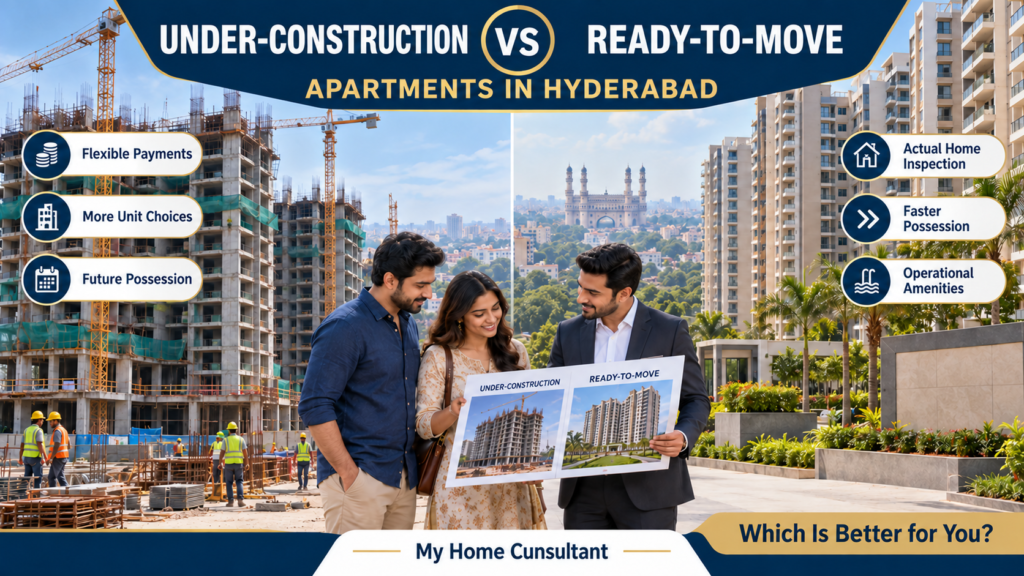
One of the most important decisions when buying an apartment in Hyderabad is whether to choose an under-construction property or a ready-to-move home.
An under-construction apartment may offer flexible payment stages and more unit choices, but the buyer must wait for construction and possession. A ready-to-move apartment allows the buyer to inspect the actual property and move in sooner, but availability, pricing and customisation options may be different.
Neither option is automatically better for everyone. The right choice depends on your budget, current rent, required possession timeline, risk tolerance, home-loan affordability and family requirements.
This guide compares under-construction and ready-to-move apartments to help Hyderabad homebuyers make a more informed decision.
What Is an Under-Construction Apartment?
An under-construction apartment is a residential unit in a project where construction is still in progress and possession will be offered at a later date.
Depending on the project stage, construction may be at:
Excavation or foundation level
Structural stage
Brickwork or internal-work stage
Finishing stage
Near-completion stage
The buyer generally makes payments according to the agreement and applicable payment schedule.
Before booking, buyers should verify the project’s registration, proposed completion date, sanctioned details, construction progress, payment conditions and developer’s past performance.
What Is a Ready-to-Move Apartment?
A ready-to-move apartment is a substantially completed residential unit that is available for possession, subject to the applicable approvals, documentation, payment and handover requirements.
The buyer can usually inspect the actual apartment, tower, common areas, lifts, water supply and available amenities before completing the purchase.
However, the words “ready to move” used in marketing material should not be accepted without verification. Buyers should check the applicable completion and occupancy-related documents and confirm whether the unit is genuinely ready for lawful occupation.
Quick Comparison
| Factor | Under-construction apartment | Ready-to-move apartment |
|---|---|---|
| Property inspection | Actual finished unit may not be available | Actual apartment can generally be inspected |
| Possession | Offered at a future date | May be available sooner after formalities |
| Payment | Often linked to stages or an agreed schedule | Larger payment may be required within a shorter period |
| Construction risk | Possibility of delay or specification changes | Construction is substantially visible |
| Unit selection | More choice may be available during early stages | Choice may be limited to remaining inventory |
| Customisation | Some changes may be possible, subject to builder policy | Major changes may require separate renovation |
| Amenities | May be proposed or under development | Existing amenities can be physically checked |
| Rent and EMI | Buyer may manage rent and loan-related payments during construction | Buyer may move in sooner and potentially stop paying rent |
| Neighbourhood | Future condition may be uncertain | Existing community and surroundings are easier to evaluate |
| Maintenance | Usually begins around possession or as stated in the agreement | May start soon after purchase or possession |
Actual conditions vary between projects. Buyers should rely on the agreement and verified documents rather than general assumptions.
1. Purchase Price and Total Cost
An under-construction apartment may sometimes be offered at a different price from a completed apartment, particularly during an early project stage. However, a lower advertised price does not always mean a lower final cost.
Calculate:
Basic property price
Floor-rise charges
Preferential-location charges
Parking charges
Amenities or clubhouse charges
Corpus fund
Advance maintenance
Applicable taxes
Registration expenses
Home-loan charges
Interior and moving costs
Rent payable until possession
For a ready-to-move apartment, also check whether maintenance dues, association charges, repair expenses or interior modifications are required.
Ask for a complete written cost sheet for both options before comparing them.
2. Payment Schedule
Under-Construction Apartment
Payments may be collected according to construction stages or another schedule specified in the agreement.
A staged payment structure may help some buyers plan their finances. However, buyers should check whether each demand is consistent with the agreement and actual progress.
Ready-to-Move Apartment
A ready property may require the buyer to arrange a substantial portion of the payment within a shorter period.
Before booking, confirm:
Booking amount
Down-payment deadline
Home-loan disbursement conditions
Registration payment
Maintenance deposit
Final amount payable before possession
Choose an option that fits your real cash flow rather than relying only on future income expectations.
3. Possession Timeline
Possession timing is one of the biggest differences between the two options.
With an under-construction apartment, buyers must wait until construction and the applicable handover requirements are completed. Delays may affect:
Current rental expenses
School planning
Workplace travel
Interior schedules
Home-loan planning
Family relocation
Review the proposed possession date, grace period and delay-related clauses in the agreement.
A ready-to-move apartment may be more suitable if you need a home soon. However, confirm the documents, payments and actual handover timeline instead of assuming that possession will be immediate.
4. Ability to Inspect the Actual Apartment
A ready-to-move apartment allows you to inspect the property that you intend to purchase.
You can examine:
Actual room dimensions
Natural light
Ventilation
Balcony view
Privacy
Construction quality
Flooring
Doors and windows
Plumbing
Electrical points
Noise
Distance from neighbouring towers
In an under-construction project, buyers may need to depend on the floor plan, specifications, sample apartment and project documents.
A model flat may use special lighting, mirrors, customised furniture or layout adjustments. Always compare it with the official floor plan and specifications mentioned in the agreement.
5. Construction Delay Risk
Construction and possession delays are possible in under-construction projects. The level of risk may depend on factors such as:
Developer’s financial position
Approval status
Project scale
Construction progress
Contractor performance
Market conditions
External restrictions
Developer’s delivery history
Before booking, review the project information on the official TG RERA portal and investigate the builder’s earlier projects.
For a ready-to-move apartment, much of the construction is already visible. However, buyers must still verify the relevant documents, building condition and pending common-area work.
6. TG RERA Verification
For an applicable under-construction project, verify:
TG RERA registration number
Promoter details
Project location
Registration validity
Proposed completion date
Available project updates
Sanctioned project information
Complaints or orders, if any
For a ready-to-move project, check the applicable registration and completion-related status.
Do not depend only on a registration number printed in a brochure. Search for the project through the official TG RERA portal.
RERA registration is an important verification point, but it should not replace independent legal and technical due diligence.
7. Legal Documents and Approvals
Whether you select an under-construction or ready-to-move apartment, arrange independent legal verification.
Depending on the property, a qualified property lawyer may need to review:
Title and ownership history
Development Agreement
General Power of Attorney, if applicable
Approved building plan
Relevant permissions
Encumbrance Certificate
Land-use documents
Builder’s authority to construct and sell
Existing mortgage or financial charge
Litigation or disputes
Agreement of Sale
For a completed property, verify the applicable Occupancy Certificate and other relevant completion documents.
GHMC provides a facility to search certain Occupancy Certificate, Building Permission and Fire NOC records through its official search page.
A bank’s willingness to finance a project should not replace independent legal verification carried out for the buyer.
8. Apartment Choices and Availability
An under-construction project may offer more choices during its early stages, such as:
Preferred tower
Higher or lower floor
Apartment direction
Balcony view
Unit size
Floor plan
Parking location, subject to policy
In a ready-to-move project, the best-positioned units may already be sold. However, the remaining units can generally be physically inspected.
Do not select a unit only because it is the last available apartment. Check why it remains unsold and whether its floor, direction, view, noise level or price suits your requirements.
9. Customisation and Interior Planning
In some under-construction projects, limited internal changes may be permitted before finishing work begins. This depends entirely on the builder’s policy, construction stage, technical feasibility and applicable rules.
Ask whether changes are allowed to:
Electrical points
Kitchen provisions
Internal finishes
Fixtures
Doors
Flooring
Obtain written confirmation of permitted changes and charges.
A ready-to-move apartment provides less opportunity to change original construction specifications. However, you can inspect the completed home and plan interiors using actual measurements.
Avoid structural or unauthorised modifications in either type of property.
10. Amenities and Common Areas
In an under-construction project, amenities may be shown through brochures, renders or sample designs. Buyers should check:
Which amenities are included
Completion timeline
Whether amenities are part of the relevant phase
Charges for clubhouse access
Maintenance implications
Whether specifications appear in the agreement
In a ready-to-move project, you may be able to inspect:
Clubhouse
Gym
Swimming pool
Children’s play area
Landscaped spaces
Internal roads
Security systems
Visitor parking
Lifts and lobbies
Fire exits
Confirm whether all advertised amenities are actually operational and available to residents.
11. Water Supply and Essential Services
Water, drainage, lifts and power backup are more important for daily living than decorative features.
For both options, investigate:
Main water source
Municipal water availability
Borewell or tanker dependency
Sewage treatment
Storm-water drainage
Power backup
Number of lifts per tower
Service-lift availability
Fire-safety provisions
Emergency access
In an under-construction project, buyers may have to depend on specifications and proposed plans.
In a ready-to-move community, speak to existing residents about actual water supply, lift performance, drainage, power backup and maintenance quality.
12. Home Loan and EMI Planning
The home-loan process may differ according to the project stage, lender’s assessment and payment schedule.
Before applying, understand:
Your preliminary eligibility
Required down payment
Loan amount
EMI affordability
Fixed or floating interest structure
Loan tenure
Processing charges
Disbursement schedule
Applicable conditions before each disbursement
With an under-construction property, loan disbursement may occur in stages, subject to the lender’s process and construction progress. Ask the lender how interest, pre-EMI or EMI will apply in your case.
For a ready-to-move apartment, a larger amount may be disbursed within a shorter period once the lender’s requirements are completed.
The Reserve Bank of India advises borrowers to understand whether a housing loan has a fixed or floating rate and how rate changes could affect repayment. Review the lender’s terms carefully.
My Home Cunsultant does not directly provide or sanction home loans. We understand a new homebuyer’s requirement, refer the available application file to a relevant bank and assist with communication and application coordination.
Loan eligibility, approval, interest rate, tenure, sanctioned amount and disbursement are determined solely by the respective bank.
13. Paying Rent Along with Loan-Related Costs
If you currently live in a rented home, an under-construction apartment may require you to continue paying rent until possession.
Your monthly commitments could include:
Rent
Loan-related payment
Existing EMIs
Household expenses
School fees
Savings
Emergency expenses
Do not assume that possession will occur exactly on the expected date. Maintain a financial buffer.
A ready-to-move apartment may allow you to shift sooner and reduce the period during which you pay rent. However, immediate EMI, maintenance, registration and interior expenses should also be included in the budget.
14. Taxes and Transaction Costs
Tax treatment can depend on the property’s construction and completion status, transaction structure and applicable law at the time of purchase.
Do not rely on general statements such as:
“No tax applies”
“The rate is always fixed”
“This charge is refundable”
“The builder will manage everything”
Ask for a written cost sheet and tax breakup. Consult a qualified tax professional or legal adviser when clarification is required.
Rules and rates may change, so verify the current treatment before completing the transaction.
15. Construction Quality and Home Inspection
Under-Construction Apartment
You may be able to observe general construction progress, but access to the selected apartment can be restricted for safety reasons.
Before possession, inspect the completed unit for:
Wall and ceiling defects
Flooring and tiles
Plumbing
Drainage
Electrical points
Doors and windows
Kitchen
Bathrooms
Balcony
Utility area
Fixtures and finishing
Ready-to-Move Apartment
The actual unit can generally be inspected before purchase or possession. This gives the buyer a clearer understanding of visible quality and condition.
A professional home quality inspection can help identify visible defects and incomplete work. It does not replace legal verification, structural certification or specialised electrical and waterproofing assessments.
16. Maintenance Charges and Community Management
For an under-construction property, ask:
When maintenance charges begin
Estimated monthly amount
Advance maintenance period
Corpus fund
How common expenses will be calculated
When the residents’ association will take over
Whether all towers will be occupied at the same time
For a ready-to-move apartment, request information about:
Current monthly maintenance
Pending increases
Water charges
Power-backup charges
Move-in charges
Association rules
Existing maintenance issues
Planned repairs or major expenses
Speak to residents where possible. Actual maintenance experience may differ from the original estimate.
17. Neighbourhood and Community Experience
An under-construction project may be located in an area that is still developing. Future roads, shops, schools and public transport may improve the location, but development timelines can change.
For a ready-to-move apartment, you can evaluate:
Occupancy level
Resident profile
Security
Noise
Traffic
Nearby construction
Water availability
Local shops
School transport
Community management
Visit the project during the morning, evening and weekend before making a final decision.
Who Should Consider an Under-Construction Apartment?
It may be suitable for buyers who:
Do not need immediate possession
Can manage rent and loan-related expenses during construction
Prefer more unit choices
Want time to plan their finances
Are comfortable monitoring project progress
Have carefully reviewed the developer and project documents
Can financially manage a possible delay
The buyer should avoid depending on future price appreciation or unverified infrastructure promises.
Who Should Consider a Ready-to-Move Apartment?
It may be suitable for buyers who:
Need a home soon
Want to inspect the actual unit
Prefer clarity about the existing view and neighbourhood
Want to evaluate operational amenities
Wish to speak to current residents
Want to avoid extended construction waiting
Can arrange the required payment within a shorter period
Ready-to-move does not mean verification can be skipped. Legal documents, applicable completion approvals, property condition and total costs must still be examined.
Questions to Ask Before Choosing
Ask the builder or seller:
What is the project’s TG RERA registration number?
What is the proposed or actual possession status?
Which applicable approvals have been obtained?
What carpet area is stated in the agreement?
Does the cost sheet include every applicable charge?
What payment schedule applies?
Are all promised amenities operational?
What is the main water source?
What is the estimated or current maintenance charge?
Can the actual apartment be inspected?
What are the cancellation and refund conditions?
Is any construction work still pending?
What home-loan disbursement conditions apply?
Can defects be reported before possession?
Will all important promises be included in writing?
Final Verdict: Which Option Is Better?
There is no single answer that suits every buyer.
Choose an under-construction apartment only after evaluating:
Developer’s track record
TG RERA details
Construction progress
Possession timeline
Payment plan
Your ability to manage a delay
Choose a ready-to-move apartment only after evaluating:
Applicable completion documents
Actual apartment condition
Amenities
Water and maintenance
Existing community
Complete purchase cost
The best apartment is not simply the cheapest or earliest available option. It should suit your family’s needs, budget, daily travel, financial capacity and acceptable level of risk.
How My Home Cunsultant Can Assist
My Home Cunsultant assists homebuyers searching for new apartment options in Hyderabad.
Our assistance may include:
Understanding your apartment requirements
Providing information about available options
Coordinating property site visits
Assisting with home quality inspection
Referring available home-loan application files to relevant banks
Coordinating communication during the bank application process
Buyers should independently verify legal documents, approvals, financial affordability and property condition. Qualified legal, engineering, tax or financial professionals should be consulted when specialised advice is required.
Frequently Asked Questions
Is an under-construction apartment cheaper than a ready-to-move apartment?
It may be priced differently depending on the project stage, location, demand and available inventory. Compare the complete cost, including rent during construction, taxes, charges, registration, maintenance and interiors.
Is a ready-to-move apartment completely risk-free?
No. Buyers should still verify the title, approvals, applicable Occupancy Certificate, agreement, property condition, maintenance dues and other relevant documents.
Can I inspect an under-construction apartment?
Access depends on the construction stage and builder’s safety policy. The completed apartment should be inspected before possession.
Which option is better if I am currently paying rent?
A ready-to-move apartment may reduce the period of paying rent and housing-loan-related costs together. Compare the complete cash flow before deciding.
Do I need to check TG RERA for a ready-to-move apartment?
Check the applicable project registration and completion information. The required verification depends on the project and its status.
Is bank project approval enough to buy an apartment?
No. A bank evaluates the property for its lending requirements. Buyers should obtain independent legal and technical verification.
Does My Home Cunsultant provide home loans?
No. My Home Cunsultant does not provide or sanction home loans. We refer the available buyer application file to a relevant bank and assist with communication and application coordination.
Should I arrange a home inspection for a new apartment?
Yes. A new apartment can also contain visible defects relating to flooring, plumbing, electrical points, doors, windows and finishing. A pre-possession inspection can help document these concerns.